Research highlights
1. A radiative transfer model for SIF simulations
Solar-induced chlorophyll fluorescence (SIF) provides a means to estimate plant photosynthetic activities and to detect early plant stress. The accurate quantification of SIF emitted by various scene components (tree crowns and background) may significantly improve the interpretation of top-of-canopy SIF (SIFtoc) measurements made over heterogeneous canopies. To do so, a three-dimensional (3-D) canopy SIF model (FluorFLiES) was introduced by coupling the excitation-fluorescence matrices (EF-matrices) with a 3-D Monte Carlo canopy radiative transfer model (Forest Light Environmental Simulator, FLiES). A tool was developed to construct forest canopy scene components from LiDAR data and enable their simulated contributions in structurally complex forest scenes. FluorFLiES is able to quantify SIF measurements with good accuracy at both half-hourly (R2 = 0.72, RMSE = 0.26 mW m−2 sr−1 nm−1) and daily (R2 = 0.83, RMSE = 0.19 mW m−2 sr−1 nm−1) scales. This study showed that non-photosynthetic elements in tree crowns, the fractional vegetation cover (FVC), and the background (including understory vegetation and soils) had a strong influence on SIFtoc intensity. Non-photosynthetic woody material suppressed the propagation of photons within crowns, thereby decreasing SIFtoc by around 10%. The canopy background made a significant contribution to SIFtoc in the NIR region by scattering downward SIF photons upward, and the background contribution increased rapidly with decreasing FVC: SIFtoc increased two-fold from 0.15 to 0.3 mW m−2 sr−1 nm−1 when ground leaf area index increased from 0.5 to 1.5 m2/m2. The results showed that the fluorescence escape ratio (fesc), a key variable relating observed SIFtoc to photosynthesis CO2 rate, contained a contribution from the background with a magnitude of 42%, even for relatively dense forest canopies. Assuming fesc simulated by the FluorFLiES model as a reference value, this study demonstrated that the current reflectance-based approach may cause large uncertainties (29%) when understory vegetation and/or FVC changes, largely due to neglecting the contribution of background elements. This study highlights the need to separate scene components and to consider multiple scattering within/among these components in interpreting the SIFtoc signal when working with heterogeneous ecosystems. The source code of FluorFLiES is available for further benchmarking.
Gao, S., Huete, A., Kobayashi, H., Doody, T.M., Liu, W., Wang, Y., Zhang, Y. and Lu, X., 2022. Simulation of solar-induced chlorophyll fluorescence in a heterogeneous forest using 3-D radiative transfer modelling and airborne LiDAR. ISPRS Journal of Photogrammetry and Remote Sensing, 191, pp.1-17.
https://doi.org/10.1016/j.isprsjprs.2022.07.004
2. Advancing Evapotranspiration modelling using SIF
Evapotranspiration (ET) describes the sum of water transfer from the ground surface through soil evaporation and water loss from leaf stomata into the atmosphere − critical factors linking the global water and carbon cycles. Myriad ET models based on remote sensing data provide spatially continuous estimates of ET; however, leaf photosynthetic information is critical to ensure accurate ET estimates, which are difficult to measure from space. Remotely sensed sun-induced chlorophyll fluorescence (SIF) provides a proxy of stomatal conductance activity with high performance in predicting plant transpiration, which can account for a large proportion of terrestrial and riverine ET. This study aims to improve estimates of tree water use in semi-arid to arid environments. In this study, a fixed stomatal conductance model and three SIF-driven canopy conductance (gsc) models were applied to model potential ET (PET). The models estimated PET using the Penman-Monteith equation with: (1) a constant leaf stomatal conductance; (2) a transpiration-driven gsc model; (3) a gsc model based on electron-transfer rate and vapor pressure deficit, and a (4) Ball-Berry stomatal conductance model. A machine learning model was then applied to scale PET to actual ET (AET) using remote sensing and climate data. Accordingly, four AET models were cross-validated with in-situ measured AET at 52 sites, including 21 eddy covariance flux tower sites, and 31 sap-flow measurement sites (semi-arid and plantation area), for various plant functional types in Australia. This study demonstrated that SIF effectively captured seasonal variations of gsc, finding that AET models with SIF-driven gsc models correlated well with in-situ measured AET (R2 = 0.64). Modelled AET with dynamic variations of gsc generated lower prediction error (0.85 mm day−1), while the AET model with fixed stomatal conductance tended to overestimate AET in floodplains and underestimate it in evergreen broadleaf forests, indicating using fixed stomatal conductance results in unstable performance when modelling AET. This study demonstrated that SIF-driven AET models improved broadscale estimation of ET. Our findings provide vital broadscale hydrological data to assist catchment and regional water management, particularly over unmonitored areas at risk of future climate-driven reductions in rainfall.
Gao, S., Nagler, P.L., Woodgate, W., Huete, A. and Doody, T.M., 2025. Advancing broadscale spatial evapotranspiration modelling by incorporating sun-induced chlorophyll fluorescence measurements. Journal of Hydrology, p.133404.
https://doi.org/10.1016/j.jhydrol.2025.133404
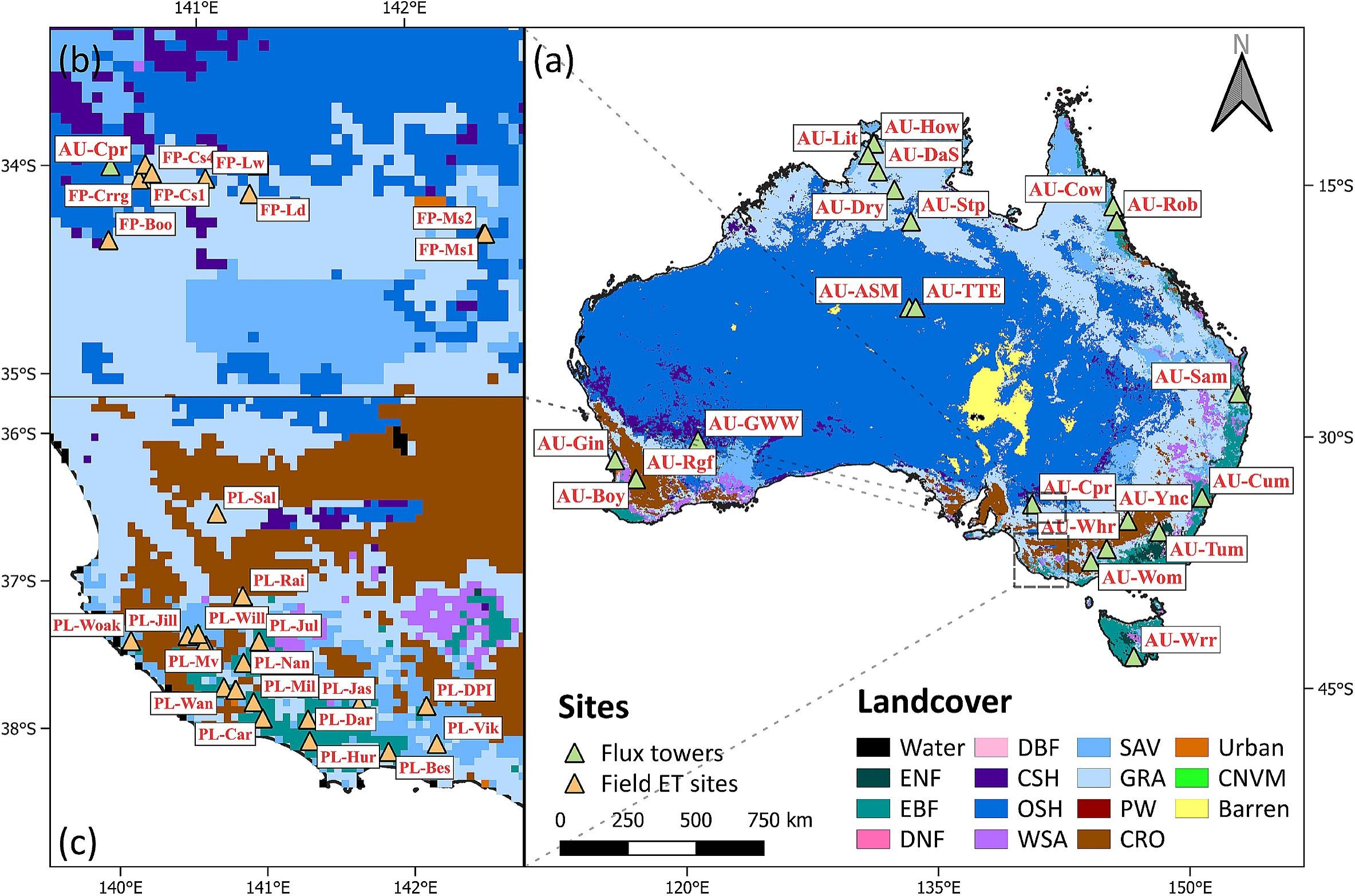
Flux towers and sap flow measurements sites for validating SIF driven ET models